Penang HomePhysio
Golfer’s Elbow Physiotherapy at Home in Penang
Pain on the inside of the elbow may appear while turning a screwdriver, chopping ingredients or gripping a club. Home assessment can identify which loads to change.
Suitability, therapist availability and any medical clearance are checked before an appointment. Rehabilitation is selected after assessment.
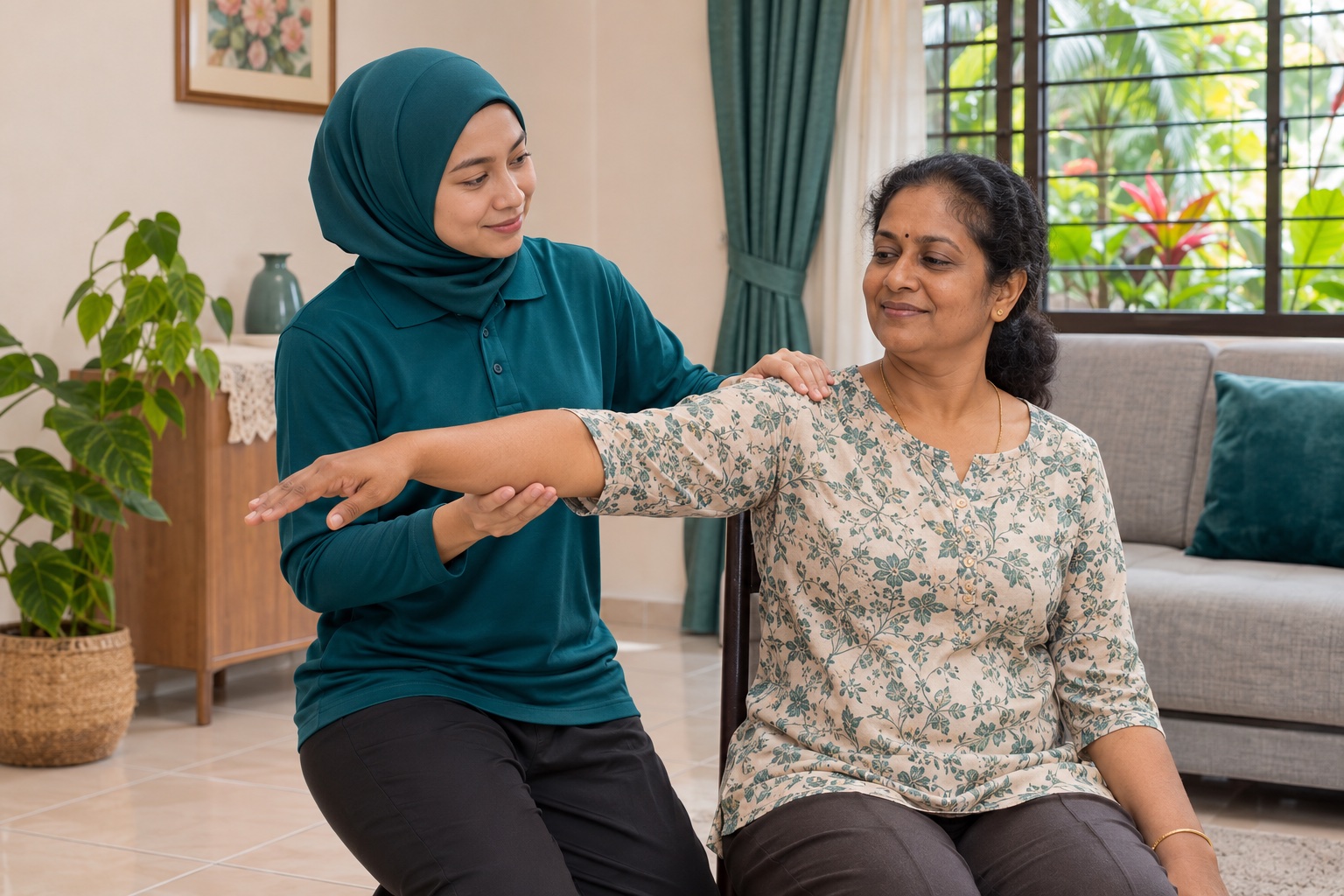
Understanding this condition
Golfer’s elbow, or medial epicondylalgia, affects the tendon attachment of muscles that bend the wrist and turn the forearm palm-down. It may develop with repeated gripping and turning in sport, work or household activities.
The ulnar nerve runs nearby. Tingling into the little and ring fingers, hand weakness or an injury during throwing should not automatically be treated as tendon pain. Assessment distinguishes these features before selecting exercises.
Symptoms and everyday difficulties
- Tenderness around the bony inside edge of the elbow.
- Pain turning a handle or stirring a thick mixture.
- Grip endurance falls during prolonged tool or club use.
Who may benefit from a home assessment
A stable person with mechanically provoked inner elbow symptoms may benefit from task assessment at home. New nerve symptoms, sudden traumatic pain or a sense of instability needs further evaluation before loading.
A condition-specific assessment
- Review gripping force, repeated forearm turning and changes in sport or workload.
- Assess wrist flexion and forearm rotation against tolerable resistance, elbow movement and finger sensation.
- Observe the person’s actual tool position and select a meaningful measure such as stirring duration.
Treatment options and how they are chosen
Flexor-pronator strengthening
- What it involves
- Select resistance for wrist bending or controlled palm-down rotation.
- Why it may be chosen
- These movements load the muscle-tendon group on the inner elbow.
- The everyday goal
- Build tolerance for stirring, turning and gripping.
- Adapting it at home
- Support the forearm on a table and choose a manageable object and lever length.
- Reviewing progress
- Compare controlled repetitions, grip comfort and next-day response.
Changing torque and grip
- What it involves
- Trial a different handle, grip pressure or work position.
- Why it may be chosen
- Turning a stiff tool with a long lever creates a different demand from light gripping.
- The everyday goal
- Make a difficult kitchen or repair task manageable.
- Adapting it at home
- Use a stable surface and practise first with an unpowered tool.
- Reviewing progress
- Record which change lowers symptoms without reducing control.
Graded return to repetitive activity
- What it involves
- Increase one element of an important activity at a time.
- Why it may be chosen
- A single movement may feel comfortable while repeated turns exceed capacity.
- The everyday goal
- Prepare for longer work periods or recreational practice.
- Adapting it at home
- Split work into shorter sets with lighter tasks between.
- Reviewing progress
- Review total duration and lingering pain before adding speed or volume.
Individual rehabilitation goals
- Turn a familiar tool comfortably.
- Regain useful grip duration.
- Identify symptoms that suggest nerve involvement.
How a home visit is arranged
- Send a brief enquiry with the rehabilitation need, area and whether you are the patient or caregiver.
- The team checks relevant information, service scope, therapist availability and suitability. Share medical documents through the arrangement agreed with the team.
- If suitable, confirm the appointment, full session fee and separate travel charge before the home assessment.
- The physiotherapist assesses the person and discusses an individual plan, consent and practical goals.
- Appropriate treatment, home practice and caregiver guidance are provided, then progress and the need for further visits are reviewed.
Preparing for the visit
Show the movement or handle involved and describe whether symptoms reach the fingers. Mention a recent throwing injury or a sudden change in sport.
Home visits and clinic rehabilitation
Home visits suit domestic and manual tasks. Throwing instability, persistent nerve symptoms or high-level return to golf may need specialist evaluation and sport-specific facilities.
When medical assessment is needed
New or worsening finger weakness or persistent numbness needs medical review. Marked swelling after trauma, deformity or a hot joint with fever needs urgent assessment rather than tendon exercises.
For a genuine medical emergency in Malaysia, call 999. A routine physiotherapy enquiry is not an emergency response. Malaysia emergency service information
Patient and caregiver questions
How does this differ from tennis elbow?
The usual site is the inside rather than the outside of the elbow. Different forearm muscle groups and loading directions are involved.
Why ask about my little finger?
The nearby ulnar nerve supplies sensation to this area. Tingling or weakness may need a nerve assessment.
Can I keep gardening?
Often tasks can be adjusted by changing grip pressure, tool selection or duration. Let the response during and after work guide the plan.
Should I practise my full golf swing at home?
Not as an initial test in a confined space. Start with assessed movement and strength; a safe practice area and coaching may be needed later.
Will pain relief prove the tendon is ready for hard work?
No. Check grip, rotational control and tolerance of repeated tasks as well as pain.
The treating physiotherapist
Penang HomePhysio confirms that a clinician is available for this service. Ask the team to confirm the treating physiotherapist's name, qualifications, registration, relevant experience and availability. Tell us your preferred spoken language so the team can check. Website language options do not establish any individual clinician's language abilities.
About the serviceHome visits around Penang
Home visits in Penang are arranged by area and therapist availability. Areas listed on this site include George Town, Bayan Lepas, Butterworth, Bukit Mertajam. Share your postcode and access needs so the team can confirm coverage and travel charges.
See coverage areasPricing and suitability enquiries
See this site's pricing guide. Tell the team your area and care needs to confirm the full fee, including any travel charge, before booking.
Clinical information sources
These sources support the general information. They are not endorsements of this provider or a claim that a clinician has reviewed this page.