Penang HomePhysio
Falls and Balance Rehabilitation at Home in Penang
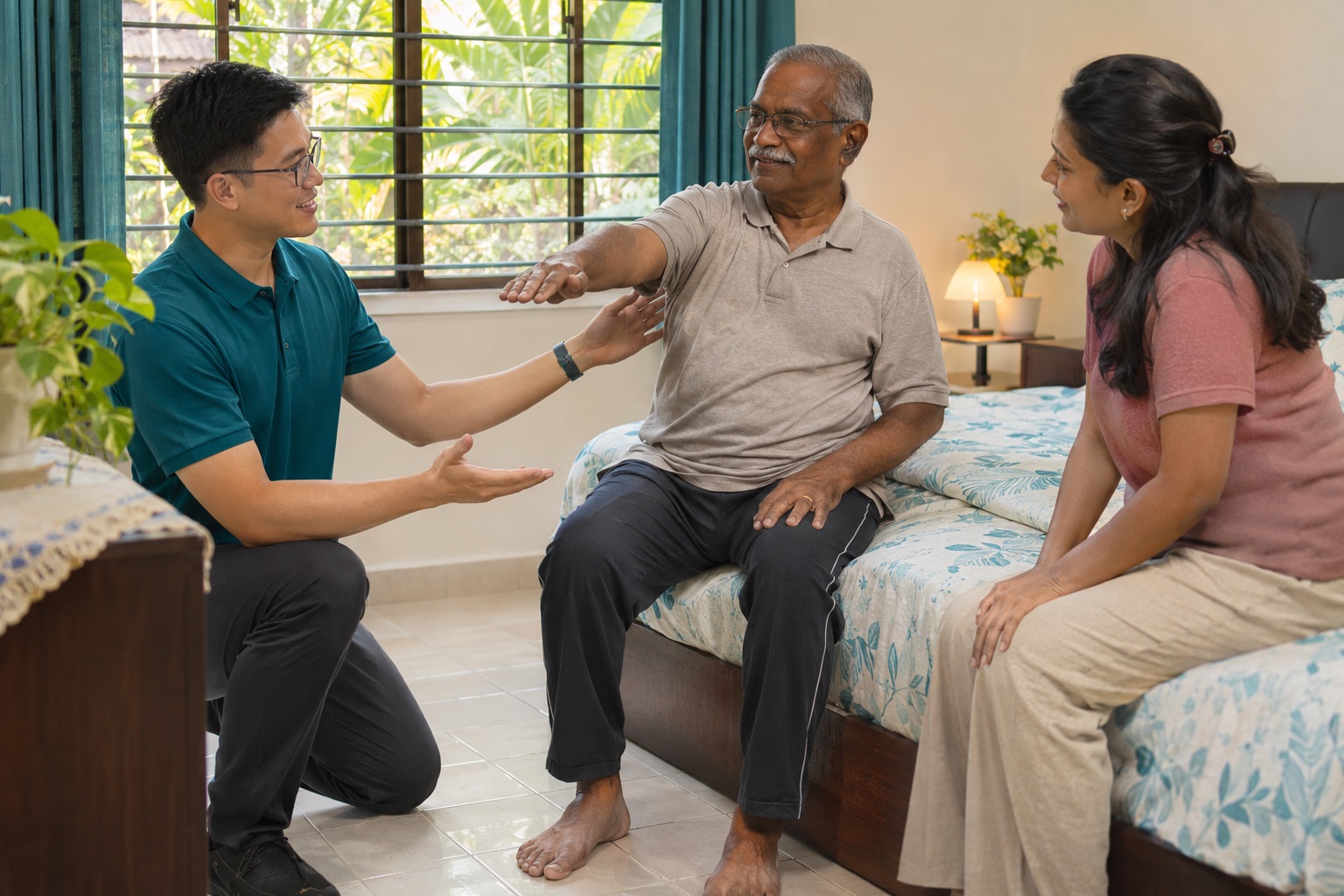
Repeated falls or increasing unsteadiness deserve assessment of the reasons, not simply advice to be more careful. Home rehabilitation can address movement and environmental difficulties alongside appropriate medical review.
Suitability, therapist availability and any medical clearance are checked before an appointment. Rehabilitation is selected after assessment.
Understanding this condition
Balance depends on vision, sensation, inner-ear function, strength and the nervous system working together. Medicines, blood-pressure changes, illness and hazards may also contribute to falls. Several factors often coexist.
Recurrent falls are a problem to investigate, not one diagnosis. A balance programme differs from treatment for a confirmed vestibular disorder, and loss of consciousness requires medical assessment rather than routine exercise alone.
Symptoms and everyday difficulties
- Swaying while standing or reaching for household objects.
- Stumbling during turns, on steps or in dim lighting.
- Restricting daily activity because of fear of another fall.
Who may benefit from a home assessment
Medically stable people with falls, near-falls or reduced confidence may benefit from an individualized home assessment. A recent injury or unexplained blackout should be medically evaluated before progressing balance challenges.
A condition-specific assessment
- Explore when each fall occurred, any dizziness or loss of consciousness, footwear, medicines and whether the person could get up.
- Observe standing, reaching, turns, chair transfers and walking, selecting tests that are safe for the person's current support needs.
- Review lighting, thresholds, bathroom access and walking-aid use; coordinate vision, medication or medical referrals when indicated.
Treatment options and how they are chosen
Tailored balance practice
- What it involves
- Practise selected weight shifts, reaching or stepping with support.
- Why it may be chosen
- Specific balance responses may need training.
- The everyday goal
- Improve control during dressing or reaching.
- Adapting it at home
- Use a safe support surface and appropriate supervision.
- Reviewing progress
- Review steadiness and support needs before increasing challenge.
Strength and practical walking
- What it involves
- Combine relevant leg strengthening with turns and household routes.
- Why it may be chosen
- Weakness and gait problems can contribute to falls together.
- The everyday goal
- Support chair rising and walking to the bathroom.
- Adapting it at home
- Match practice to actual floors, doorways and the usual aid.
- Reviewing progress
- Track task control, near-falls and confidence rather than speed alone.
Aid and home-safety training
- What it involves
- Review aid fit and practise safe positioning; discuss identified home hazards.
- Why it may be chosen
- An unsuitable aid or clutter can undermine good exercise progress.
- The everyday goal
- Make routine movement more manageable.
- Adapting it at home
- Demonstrate safe aid use on the person's own routes with caregiver involvement when agreed.
- Reviewing progress
- Recheck use and whether recommended changes are practical.
Individual rehabilitation goals
- Move around essential rooms with greater confidence.
- Improve balance responses and useful leg strength.
- Reduce modifiable fall risks without promising that every fall can be prevented.
How a home visit is arranged
- Send a brief enquiry with the rehabilitation need, area and whether you are the patient or caregiver.
- The team checks relevant information, service scope, therapist availability and suitability. Share medical documents through the arrangement agreed with the team.
- If suitable, confirm the appointment, full session fee and separate travel charge before the home assessment.
- The physiotherapist assesses the person and discusses an individual plan, consent and practical goals.
- Appropriate treatment, home practice and caregiver guidance are provided, then progress and the need for further visits are reviewed.
Preparing for the visit
Keep a note of recent falls and medicines. Leave usual walking routes visible and have the normal shoes and walking aid ready. Do not practise unsupported challenges before assessment.
Home visits and clinic rehabilitation
Home visits reveal environmental causes that a clinic may miss. Specialist vestibular testing, cardiac investigations or a broader falls service may be necessary; exercise alone does not address every cause.
When medical assessment is needed
Seek urgent care after a fall with head injury, severe pain, suspected fracture, new weakness or inability to get up safely. Blackouts, chest pain or sudden neurological symptoms need urgent assessment.
For a genuine medical emergency in Malaysia, call 999. A routine physiotherapy enquiry is not an emergency response. Malaysia emergency service information
Patient and caregiver questions
Does falling mean I need a walking frame?
Not always. The therapist assesses the cause, walking ability and suitable support rather than automatically prescribing one aid.
Should I stop walking to avoid falls?
Unnecessary inactivity can reduce strength. Agree a safe level of supported activity while causes are investigated.
Can dizziness be treated with balance exercise alone?
No. Dizziness has different causes. Assessment may require medical or vestibular referral before exercises are selected.
Can a caregiver help with practice?
Yes, when taught the agreed supervision and assistance. Pulling on the person's arms or attempting unsafe lifting should be avoided.
Will physiotherapy prevent every fall?
No. The aim is to address modifiable risks and improve function; ongoing medical review and home support may still be needed.
The treating physiotherapist
Penang HomePhysio confirms that a clinician is available for this service. Ask the team to confirm the treating physiotherapist's name, qualifications, registration, relevant experience and availability. Tell us your preferred spoken language so the team can check. Website language options do not establish any individual clinician's language abilities.
About the serviceHome visits around Penang
Home visits in Penang are arranged by area and therapist availability. Areas listed on this site include George Town, Bayan Lepas, Butterworth, Bukit Mertajam. Share your postcode and access needs so the team can confirm coverage and travel charges.
See coverage areasPricing and suitability enquiries
See this site's pricing guide. Tell the team your area and care needs to confirm the full fee, including any travel charge, before booking.
Clinical information sources
These sources support the general information. They are not endorsements of this provider or a claim that a clinician has reviewed this page.