Penang HomePhysio
Cervical Disc Herniation Rehabilitation at Home in Penang
Learn about rehabilitation for a cervical disc herniation, with individual neck and arm assessment, activity advice and neurological precautions.
Suitability, therapist availability and any medical clearance are checked before an appointment. Rehabilitation is selected after assessment.
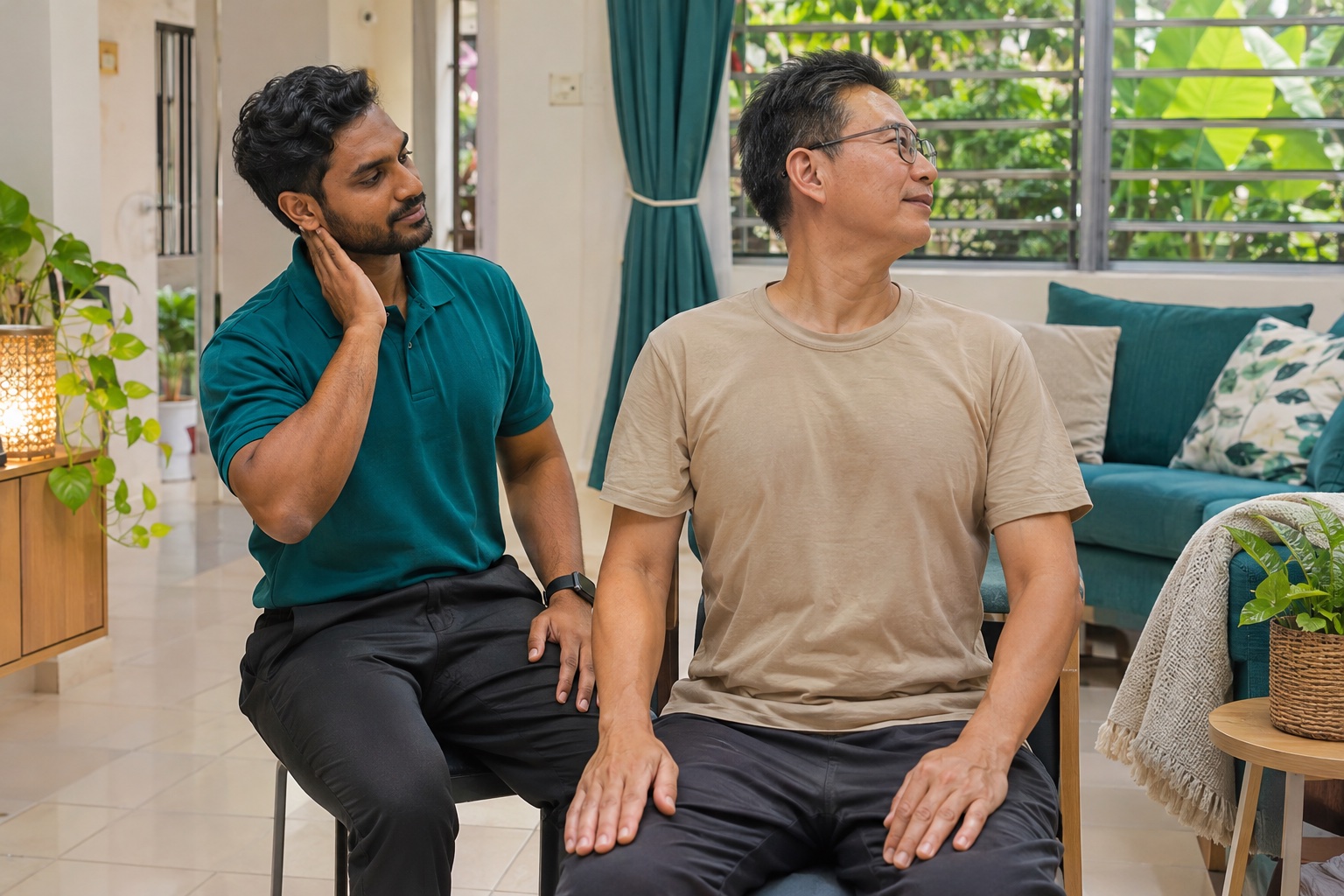
Understanding this condition
A cervical disc herniation occurs when material from a disc between neck vertebrae bulges or moves through its outer layer. It may irritate a nearby nerve root, producing arm symptoms, but a disc finding on a scan can also occur without symptoms.
The disc diagnosis describes a structural change; cervical radiculopathy describes nerve-root dysfunction. They can coexist without being identical. Treatment decisions depend on symptoms, examination and medical findings. Rehabilitation after cervical surgery follows separate surgical instructions.
Symptoms and everyday difficulties
- Neck or shoulder discomfort associated with certain movements.
- Pain, tingling or numbness extending into an arm when a nerve is affected.
- Reduced ability to reach, carry or perform fine hand tasks if weakness develops.
Who may benefit from a home assessment
Home rehabilitation may suit medically assessed, stable symptoms where everyday movement or travel is difficult. Significant or progressive weakness, possible spinal cord involvement or uncertain acute injury requires medical review before routine treatment.
A condition-specific assessment
- Clarify the medical diagnosis, imaging context, symptom onset and whether surgery or restrictions are being considered.
- Assess neck and shoulder movement together with relevant strength, sensation and reflexes, without assuming every symptom comes from the scan.
- Review lifting, computer use, sleep and hand function, and screen for gait, dexterity or bladder changes.
Treatment options and how they are chosen
Individual movement selection
- What it involves
- A clinician tests comfortable neck and arm movements and selects practice according to the response.
- Why it may be chosen
- Some movement directions may be better tolerated than others; no single exercise suits every disc problem.
- The everyday goal
- Practice aims to make looking around and using the arm more manageable.
- Adapting it at home
- Use supported positions and brief sessions within the assessed tolerance.
- Reviewing progress
- Monitor pain distribution, sensation and neurological findings, not just neck flexibility.
Restoring task-related capacity
- What it involves
- Graded neck, shoulder and arm exercises address the deficits found during assessment.
- Why it may be chosen
- Strength and control may be reduced through pain, nerve dysfunction or reduced activity.
- The everyday goal
- Targets include carrying light items, grooming and supported desk tasks.
- Adapting it at home
- Loads and positions are adapted to household equipment and any medical restrictions.
- Reviewing progress
- Reassess task performance and strength; increased neurological symptoms require review rather than automatic progression.
Load and activity planning
- What it involves
- Daily tasks are reorganised to avoid repeated symptom-provoking loading while maintaining appropriate activity.
- Why it may be chosen
- This can help the person manage necessary work without prolonged rest or rigid avoidance.
- The everyday goal
- The focus is tolerable sitting, sleep, reaching and lifting.
- Adapting it at home
- Divide loads, vary positions and arrange frequently used items within comfortable reach.
- Reviewing progress
- Review activity tolerance and next-day response to decide what should change.
Individual rehabilitation goals
- Complete selected self-care tasks with less disruption from symptoms.
- Build confidence in safe, appropriate neck and arm movement.
- Understand when medical reassessment is more important than exercise progression.
How a home visit is arranged
- Send a brief enquiry with the rehabilitation need, area and whether you are the patient or caregiver.
- The team checks relevant information, service scope, therapist availability and suitability. Share medical documents through the arrangement agreed with the team.
- If suitable, confirm the appointment, full session fee and separate travel charge before the home assessment.
- The physiotherapist assesses the person and discusses an individual plan, consent and practical goals.
- Appropriate treatment, home practice and caregiver guidance are provided, then progress and the need for further visits are reviewed.
Preparing for the visit
Bring the referral and scan report if available, describe any hand weakness, and share existing lifting or work restrictions. Do not start a collar, traction device or forceful neck routine without appropriate advice.
Home visits and clinic rehabilitation
Home treatment can address real work and sleep arrangements. Persistent or worsening neurological deficits, diagnostic uncertainty or surgical decisions require medical services. A home programme cannot decompress the spinal cord or guarantee that a disc will change.
When medical assessment is needed
Seek urgent assessment for worsening weakness, new hand clumsiness, walking imbalance, or bowel or bladder changes. Severe symptoms after trauma also need medical care. Sudden facial weakness or speech difficulty requires emergency assessment.
For a genuine medical emergency in Malaysia, call 999. A routine physiotherapy enquiry is not an emergency response. Malaysia emergency service information
Patient and caregiver questions
Can exercises push the disc back in?
Exercises are chosen to improve symptoms and function, not to mechanically push a disc into place. Structural change cannot be promised.
Does a herniation mean I need surgery?
Not necessarily. Medical decisions depend on neurological findings, symptom progression and response to appropriate care, not the scan label alone.
Is arm pain always caused by the disc?
No. Shoulder and peripheral nerve problems can produce similar symptoms. Examination checks whether the disc finding fits the clinical picture.
Should I stretch through arm numbness?
Do not force a stretch that increases or spreads numbness. Stop and discuss the response; new weakness requires prompt medical review.
Is this the same programme used after neck surgery?
No. Postoperative rehabilitation must follow the specific operation, healing considerations and surgeon’s restrictions. Share those instructions before any session.
The treating physiotherapist
Penang HomePhysio confirms that a clinician is available for this service. Ask the team to confirm the treating physiotherapist's name, qualifications, registration, relevant experience and availability. Tell us your preferred spoken language so the team can check. Website language options do not establish any individual clinician's language abilities.
About the serviceHome visits around Penang
Home visits in Penang are arranged by area and therapist availability. Areas listed on this site include George Town, Bayan Lepas, Butterworth, Bukit Mertajam. Share your postcode and access needs so the team can confirm coverage and travel charges.
See coverage areasPricing and suitability enquiries
See this site's pricing guide. Tell the team your area and care needs to confirm the full fee, including any travel charge, before booking.
Clinical information sources
These sources support the general information. They are not endorsements of this provider or a claim that a clinician has reviewed this page.