Penang HomePhysio
Hip Labral Injury Rehabilitation at Home in Penang
Deep groin pain or painful catching when pivoting can make a car transfer or a turn in the kitchen difficult. Assessment checks whether a labral finding fits the symptoms.
Suitability, therapist availability and any medical clearance are checked before an appointment. Rehabilitation is selected after assessment.
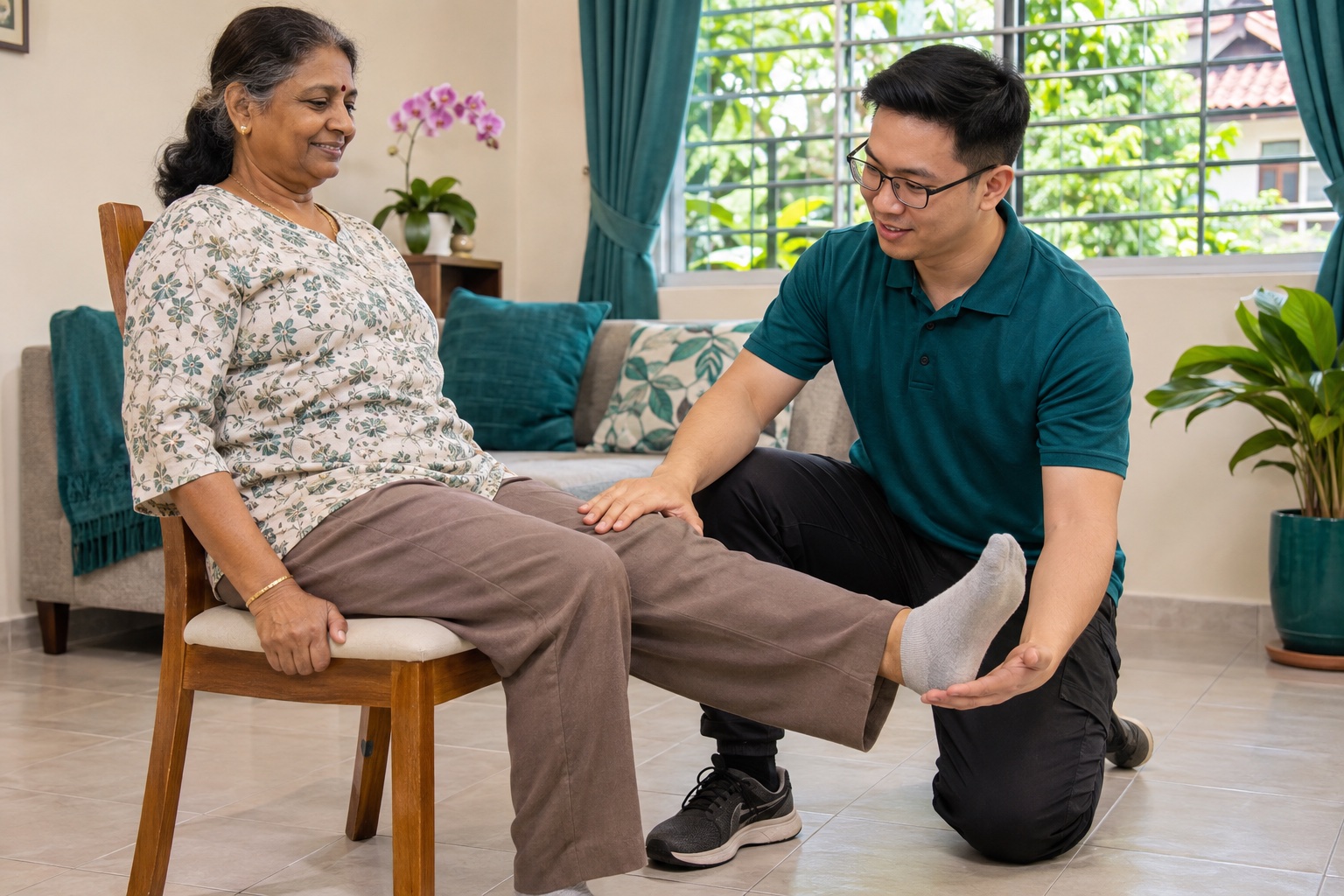
Understanding this condition
The hip labrum is a ring of firm tissue around the socket that contributes to joint stability and its seal. An injury may follow twisting, repeated loading or be associated with hip shape. Some labral tears found on imaging cause no symptoms.
Painful catching is not proof of a tear, and a labral injury is not synonymous with femoroacetabular impingement syndrome. Treatment considers the whole hip, daily demands and medical assessment. A labral repair or other hip arthroscopy requires a separate postoperative plan.
Symptoms and everyday difficulties
- Groin pain with twisting or getting into a low car.
- Painful clicking, catching or a feeling that motion is interrupted.
- Prolonged sitting or deep bending becomes uncomfortable.
Who may benefit from a home assessment
Home rehabilitation may suit a stable person following assessment when the agreed approach is nonsurgical. A truly locked joint, significant trauma or inability to bear weight needs medical review before movement practice.
A condition-specific assessment
- Review the onset, injury mechanism, scan findings and whether catching is painful or blocks movement.
- Assess tolerable hip range, strength and control without repeatedly reproducing a pinch or catch.
- Observe turning, chair rise or car-entry simulation and determine what can be modified safely.
Treatment options and how they are chosen
Managing painful pivots
- What it involves
- Identify turning or deep-flexion tasks that repeatedly cause catching and trial alternatives.
- Why it may be chosen
- Avoiding repeated provocation can help maintain activity while symptoms are assessed.
- The everyday goal
- Target turning in a kitchen or moving out of a car.
- Adapting it at home
- Reposition the feet or change seat height instead of twisting on a planted leg.
- Reviewing progress
- Compare catching frequency and ease of the specific manoeuvre.
Hip and trunk control
- What it involves
- Train selected hip and trunk muscles in ranges that do not cause persistent catching.
- Why it may be chosen
- Better control can support weight transfer even without changing the labrum itself.
- The everyday goal
- Work towards stepping and turning steadily.
- Adapting it at home
- Use a counter for support and adapt resistance to the available space.
- Reviewing progress
- Review control, tolerance and later joint symptoms before adding challenge.
Graded return to valued activity
- What it involves
- Break an avoided walking or work task into tolerable stages.
- Why it may be chosen
- Prolonged avoidance can reduce capacity while rapid return may reproduce symptoms.
- The everyday goal
- Aim to complete an ordinary route or shift of light duties.
- Adapting it at home
- Vary duration before adding faster pivots or heavier demands.
- Reviewing progress
- Track pain, locking and recovery; persistent mechanical symptoms need reassessment.
Individual rehabilitation goals
- Enter a car with a comfortable strategy.
- Turn during household tasks without repeated catching.
- Resume a selected activity within the agreed plan.
How a home visit is arranged
- Send a brief enquiry with the rehabilitation need, area and whether you are the patient or caregiver.
- The team checks relevant information, service scope, therapist availability and suitability. Share medical documents through the arrangement agreed with the team.
- If suitable, confirm the appointment, full session fee and separate travel charge before the home assessment.
- The physiotherapist assesses the person and discusses an individual plan, consent and practical goals.
- Appropriate treatment, home practice and caregiver guidance are provided, then progress and the need for further visits are reviewed.
Preparing for the visit
Have any hip MRI or orthopaedic report available. Describe the difference between a harmless click and an episode in which pain prevents movement; do not deliberately provoke locking.
Home visits and clinic rehabilitation
Home assessment suits daily pivots, sitting and early strength. Persistent painful locking, uncertainty about the labrum or consideration of surgery needs specialist assessment. Return to cutting sports usually needs suitable space and testing.
When medical assessment is needed
A hip that becomes truly locked, severe pain after injury or inability to bear weight needs urgent evaluation. Fever with a hot painful joint is also urgent. An occasional painless click alone is not an emergency.
For a genuine medical emergency in Malaysia, call 999. A routine physiotherapy enquiry is not an emergency response. Malaysia emergency service information
Patient and caregiver questions
Does every labral tear on MRI need treatment?
No. Some tears are incidental. The findings should fit the symptoms and examination before planning treatment.
Can exercise stitch a labrum back together?
No. Rehabilitation targets movement, strength and daily function. It does not surgically repair the tissue.
Should I keep testing the click?
Repeatedly provoking painful catching offers little useful information. Describe the trigger and practise a tolerable alternative.
Is all groin pain a labral tear?
No. Hip arthritis, impingement, muscle injury and non-hip causes can overlap. Examination and sometimes medical testing help clarify the source.
Can I follow this after arthroscopy?
Not without the surgical plan. A repair, trimming procedure or bone procedure may have different movement and weight-bearing restrictions.
The treating physiotherapist
Penang HomePhysio confirms that a clinician is available for this service. Ask the team to confirm the treating physiotherapist's name, qualifications, registration, relevant experience and availability. Tell us your preferred spoken language so the team can check. Website language options do not establish any individual clinician's language abilities.
About the serviceHome visits around Penang
Home visits in Penang are arranged by area and therapist availability. Areas listed on this site include George Town, Bayan Lepas, Butterworth, Bukit Mertajam. Share your postcode and access needs so the team can confirm coverage and travel charges.
See coverage areasPricing and suitability enquiries
See this site's pricing guide. Tell the team your area and care needs to confirm the full fee, including any travel charge, before booking.
Clinical information sources
These sources support the general information. They are not endorsements of this provider or a claim that a clinician has reviewed this page.