Penang HomePhysio
Tibia Fracture Rehabilitation at Home in Penang
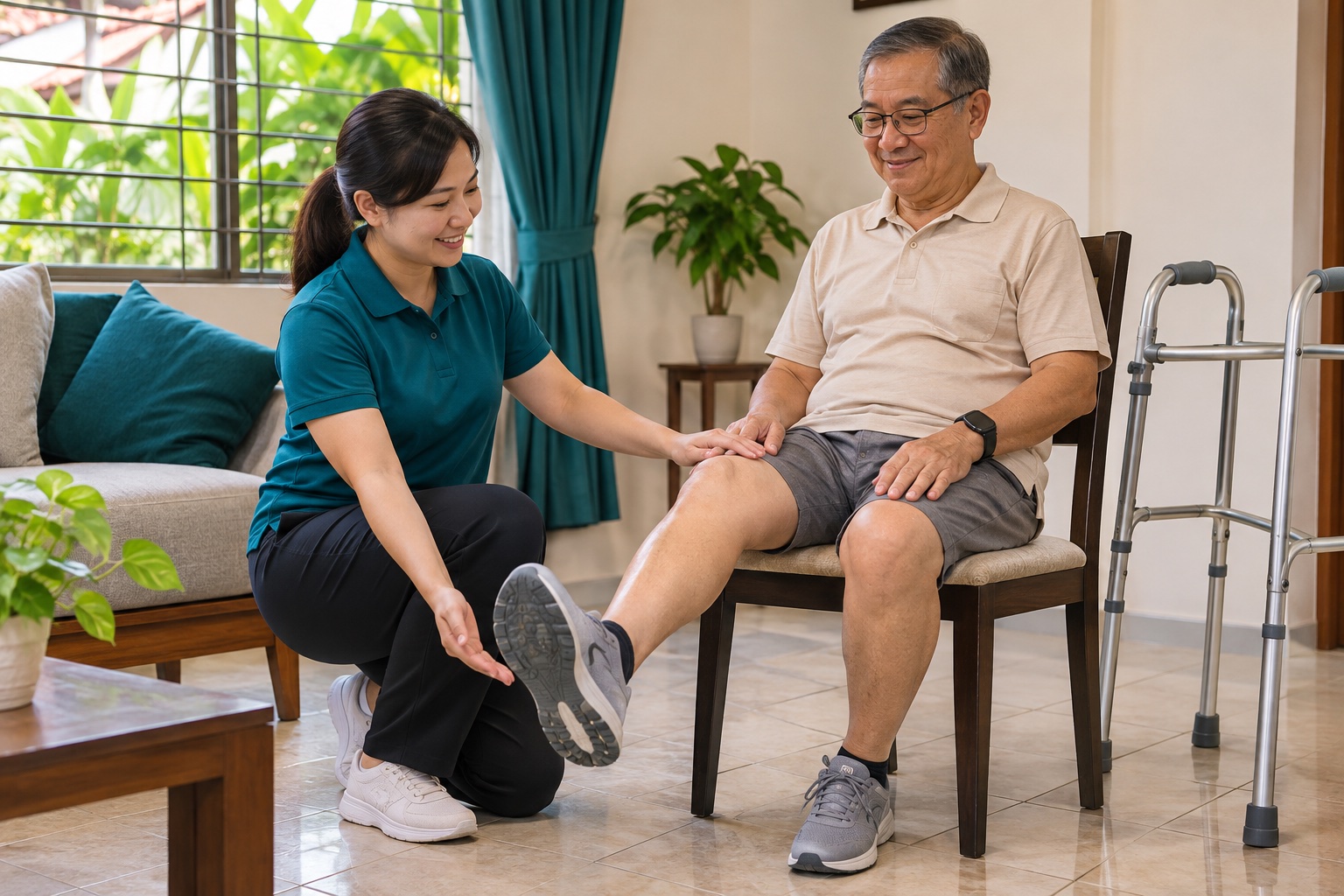
Standing to cook may be unrealistic while loading is restricted. A home assessment considers ways to move, reach essentials and maintain permitted knee and ankle movement while the bone heals.
Suitability, therapist availability and any medical clearance are checked before an appointment. Rehabilitation is selected after assessment.
Understanding this condition
The tibia is the larger load-bearing bone of the lower leg. A shaft fracture differs from a plateau fracture involving the knee or a distal fracture involving the ankle.
Treatment may use casting, a nail, plate or external fixation. The location, soft tissues and associated injuries guide loading and joint movement, not the type of metalwork alone.
Symptoms and everyday difficulties
- Lifting the leg onto the bed may be difficult.
- Knee or ankle stiffness can limit a comfortable seated posture.
- Carrying objects while using two aids can be unsafe.
Who may benefit from a home assessment
After treatment and medical clearance, a home review suits someone who must manage a restricted load or unfamiliar equipment. Complex wounds or external fixation may need coordinated specialist follow-up.
A condition-specific assessment
- Confirm the fracture level, soft-tissue injury, fixation and exact loading and motion orders.
- Observe transfers and whether the leg can be managed without twisting or excess load.
- Examine allowed knee and ankle movement, muscle activation and safe routes to essential rooms.
Treatment options and how they are chosen
Protected access
- What it involves
- Rehearse an appropriate transfer and aid sequence.
- Why it may be chosen
- The healing tibia may not tolerate ordinary standing loads.
- The everyday goal
- This enables access to a chair or toilet.
- Adapting it at home
- Set up a short route with a safe landing space.
- Reviewing progress
- Review whether limits can be maintained when tired.
Adjacent joint motion
- What it involves
- Guide knee or ankle movement only where released.
- Why it may be chosen
- Immobilisation can leave the uninjured joints stiff.
- The everyday goal
- Useful bend makes sitting and foot positioning easier.
- Adapting it at home
- Practise with the lower leg supported as directed.
- Reviewing progress
- Compare usable range, swelling and pain response.
Reloading for gait
- What it involves
- After the team changes permission, practise the newly allowed load with support.
- Why it may be chosen
- A long protected period can alter step rhythm.
- The everyday goal
- This addresses a hesitant step towards the kitchen.
- Adapting it at home
- Use the prescribed aid on level flooring first.
- Reviewing progress
- Review technique, tolerance and later symptoms before progressing.
Individual rehabilitation goals
- Transfer without exceeding the allowed load.
- Keep cleared joints mobile for sitting.
- Walk a chosen indoor route when medically permitted.
How a home visit is arranged
- Send a brief enquiry with the rehabilitation need, area and whether you are the patient or caregiver.
- The team checks relevant information, service scope, therapist availability and suitability. Share medical documents through the arrangement agreed with the team.
- If suitable, confirm the appointment, full session fee and separate travel charge before the home assessment.
- The physiotherapist assesses the person and discusses an individual plan, consent and practical goals.
- Appropriate treatment, home practice and caregiver guidance are provided, then progress and the need for further visits are reviewed.
Preparing for the visit
Prepare the operation or fracture letter, latest imaging instructions and any brace or aid. Point out steps and where the leg can be supported at rest.
Home visits and clinic rehabilitation
Home suits transfers and essential access. Bone union, alignment, pin-site problems and progression of loading require the fracture team. Complex gait or work demands may need a rehabilitation facility.
When medical assessment is needed
Severe escalating lower-leg pain, tense swelling, numbness, weakness or pain out of proportion to the injury requires emergency assessment for circulation or compartment problems. Fever or drainage around wounds or pins needs urgent clinical review.
For a genuine medical emergency in Malaysia, call 999. A routine physiotherapy enquiry is not an emergency response. Malaysia emergency service information
Patient and caregiver questions
Is a plateau fracture managed like a shaft fracture?
Not necessarily. The plateau forms part of the knee joint, so movement and loading advice can differ.
Can I walk because I have a nail?
Metal fixation alone is not clearance. Follow the written loading order and fracture review.
Should I stretch through sharp pain?
No. Stop and discuss the site and response. New severe pain requires medical assessment.
Who manages external fixator pins?
Follow the surgical team's pin-care plan. A movement visit does not replace pin-site or infection review.
When is work on uneven ground appropriate?
Discuss the actual loads and surfaces after clearance; strength, control and stamina may need testing outside the home.
The treating physiotherapist
Penang HomePhysio confirms that a clinician is available for this service. Ask the team to confirm the treating physiotherapist's name, qualifications, registration, relevant experience and availability. Tell us your preferred spoken language so the team can check. Website language options do not establish any individual clinician's language abilities.
About the serviceHome visits around Penang
Home visits in Penang are arranged by area and therapist availability. Areas listed on this site include George Town, Bayan Lepas, Butterworth, Bukit Mertajam. Share your postcode and access needs so the team can confirm coverage and travel charges.
See coverage areasPricing and suitability enquiries
See this site's pricing guide. Tell the team your area and care needs to confirm the full fee, including any travel charge, before booking.
Clinical information sources
These sources support the general information. They are not endorsements of this provider or a claim that a clinician has reviewed this page.