Penang HomePhysio
Upper Back Pain Physiotherapy at Home in Penang
Learn about thoracic pain assessment and home physiotherapy in Penang, with practical reaching, sitting and turning goals and appropriate medical screening.
Suitability, therapist availability and any medical clearance are checked before an appointment. Rehabilitation is selected after assessment.
Understanding this condition
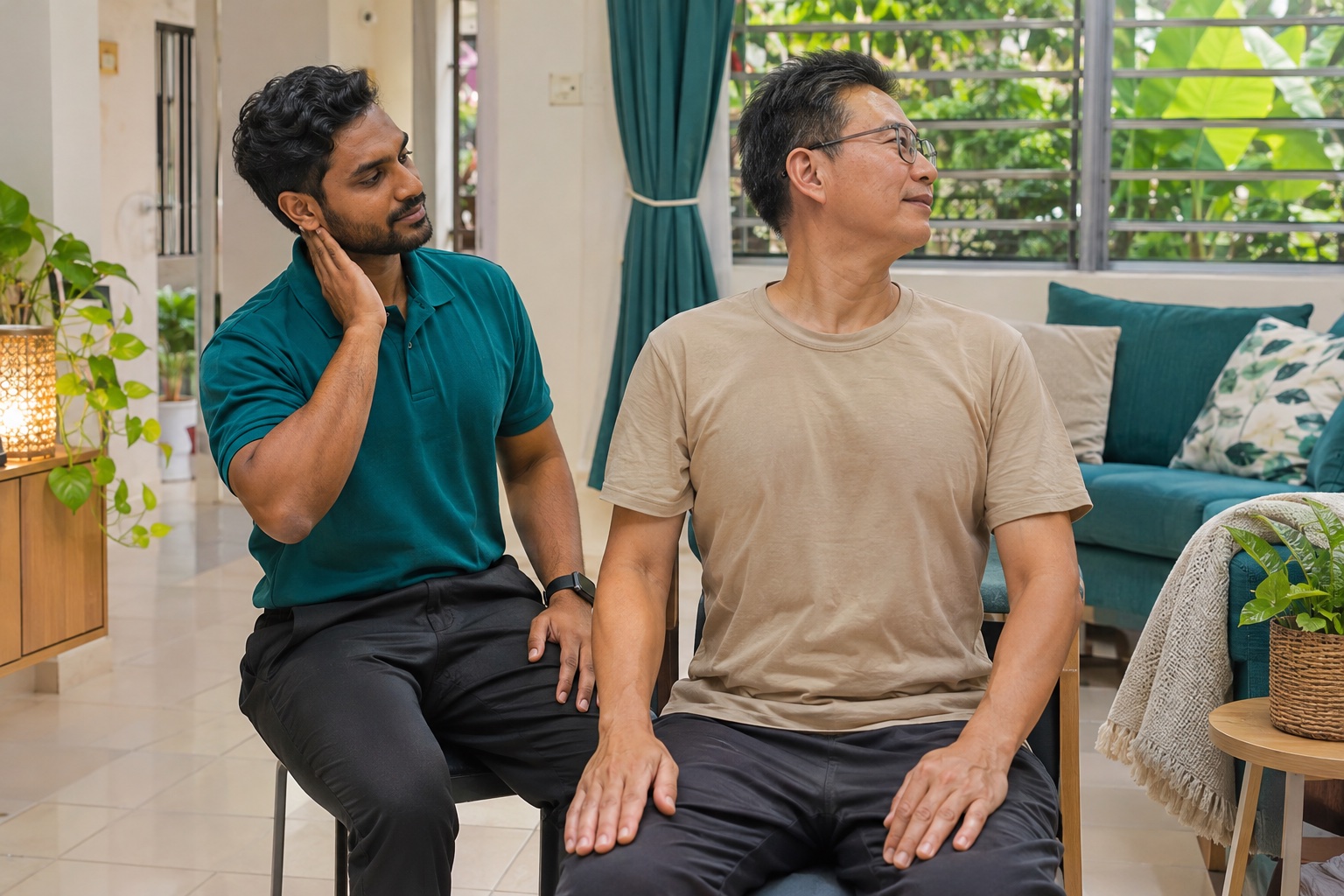
Upper-back or thoracic pain affects the region between the neck and lower back, including the area around the shoulder blades. Muscles, joints and rib-related movement may contribute, but pain here should not automatically be blamed on posture.
The assessment considers neck or shoulder referral, injury, bone health and non-musculoskeletal causes. Physiotherapy may help suitable movement-related problems through activity and strength work. Suspected fractures, chest conditions or systemic illness require medical care rather than a standard exercise routine.
Symptoms and everyday difficulties
- Sitting at a desk or preparing food may cause an ache between the shoulder blades.
- Turning to reach behind or lifting objects can feel restricted.
- Stiffness may reduce comfortable trunk movement during dressing or household tasks.
Who may benefit from a home assessment
Home assessment can help when symptoms affect work or household positions and serious causes have been considered. Unexplained new thoracic pain, especially with illness or fracture risk, deserves medical review before routine treatment.
A condition-specific assessment
- Discuss onset, injury, chest or breathing symptoms, night pain, bone health and any history relevant to serious illness.
- Assess neck, shoulder and thoracic movement as appropriate, identifying which movements reproduce the familiar problem.
- Observe sitting, reaching and lifting, and set a useful baseline such as completing a meal preparation task comfortably.
Treatment options and how they are chosen
Thoracic and shoulder mobility
- What it involves
- Practise selected turning and reaching movements within a suitable range.
- Why it may be chosen
- Movement practice may help when stiffness limits ordinary activity.
- The everyday goal
- The goal is easier dressing, reaching and looking around.
- Adapting it at home
- Use a stable chair or supported position that suits the available space.
- Reviewing progress
- Review range and task comfort without forcing painful end positions.
Postural muscle endurance
- What it involves
- Build appropriate shoulder-girdle and trunk strength with progressive loading.
- Why it may be chosen
- Improved endurance can support tasks that require sustained arm or trunk activity.
- The everyday goal
- Focus on cooking, desk work and carrying manageable items.
- Adapting it at home
- Use simple resistance only after technique and suitability are assessed.
- Reviewing progress
- Compare task duration, fatigue and movement quality rather than aiming for one ideal posture.
Work and household adaptation
- What it involves
- Adjust reach distances, work height and breaks during sustained tasks.
- Why it may be chosen
- Small practical changes may reduce repeated aggravation while maintaining activity.
- The everyday goal
- This addresses desk use, food preparation and repetitive lifting.
- Adapting it at home
- Review the person’s actual workstation or kitchen layout.
- Reviewing progress
- Check whether the changes improve useful participation and revise them if they do not.
Individual rehabilitation goals
- Turn and reach more comfortably.
- Tolerate necessary seated or standing tasks.
- Understand which symptoms need further assessment.
How a home visit is arranged
- Send a brief enquiry with the rehabilitation need, area and whether you are the patient or caregiver.
- The team checks relevant information, service scope, therapist availability and suitability. Share medical documents through the arrangement agreed with the team.
- If suitable, confirm the appointment, full session fee and separate travel charge before the home assessment.
- The physiotherapist assesses the person and discusses an individual plan, consent and practical goals.
- Appropriate treatment, home practice and caregiver guidance are provided, then progress and the need for further visits are reviewed.
Preparing for the visit
Prepare relevant reports and describe any injury or osteoporosis diagnosis. Show your usual work area and the task that causes difficulty; do not assume a posture device is needed.
Home visits and clinic rehabilitation
Home visits can assess the environment directly. Imaging, fracture evaluation, cardiopulmonary investigation or specialist care require medical services when indicated. Not every upper-back pain problem is suitable for home physiotherapy.
When medical assessment is needed
Seek emergency care for upper-back pain with chest pain, severe breathlessness, collapse or sudden neurological symptoms. Fever, unexplained weight loss, significant trauma or new pain with osteoporosis requires prompt medical review.
For a genuine medical emergency in Malaysia, call 999. A routine physiotherapy enquiry is not an emergency response. Malaysia emergency service information
Patient and caregiver questions
Is upper-back pain always caused by poor posture?
No. Posture is only one consideration; the history and examination must also consider injury, bone health and other medical causes.
Should I force my back to crack?
No. Forceful self-manipulation is unnecessary and may be unsuitable, particularly when bone fragility or injury is possible.
Can pain while breathing be muscular?
It can have several causes. New or unexplained breathing-related pain should be medically assessed, especially with breathlessness or chest symptoms.
Will a new chair solve it?
Not necessarily. Activity variation, task layout and individual movement capacity matter; an expensive chair is not automatically required.
Can I continue household work?
Appropriate tasks may continue with changes in load or duration after assessment. Serious symptoms or injury require medical guidance first.
The treating physiotherapist
Penang HomePhysio confirms that a clinician is available for this service. Ask the team to confirm the treating physiotherapist's name, qualifications, registration, relevant experience and availability. Tell us your preferred spoken language so the team can check. Website language options do not establish any individual clinician's language abilities.
About the serviceHome visits around Penang
Home visits in Penang are arranged by area and therapist availability. Areas listed on this site include George Town, Bayan Lepas, Butterworth, Bukit Mertajam. Share your postcode and access needs so the team can confirm coverage and travel charges.
See coverage areasPricing and suitability enquiries
See this site's pricing guide. Tell the team your area and care needs to confirm the full fee, including any travel charge, before booking.
Clinical information sources
These sources support the general information. They are not endorsements of this provider or a claim that a clinician has reviewed this page.