Penang HomePhysio
Ataxia Rehabilitation at Home in Penang
Missing the cup when reaching or veering across a room can reflect impaired coordination. Assessment starts with the cause and the safest way to perform one useful task.
Suitability, therapist availability and any medical clearance are checked before an appointment. Rehabilitation is selected after assessment.
Understanding this condition
Ataxia describes impaired coordination. It can affect the trunk, arms, legs, speech or eye movements and has several possible causes.
Someone may have enough muscle strength to stand yet be unable to place the feet reliably. Repeated strengthening alone may not address that problem.
Symptoms and everyday difficulties
- Overshooting an object when reaching
- Unsteady turning even without leg pain
- Difficulty keeping the trunk steady while using both hands
Who may benefit from a home assessment
A person with medically assessed stable or progressive ataxia may benefit when falls, imprecise reaching or fatigue interfere with household activities.
A condition-specific assessment
- Check diagnosis and timing, distinguishing longstanding change from sudden onset.
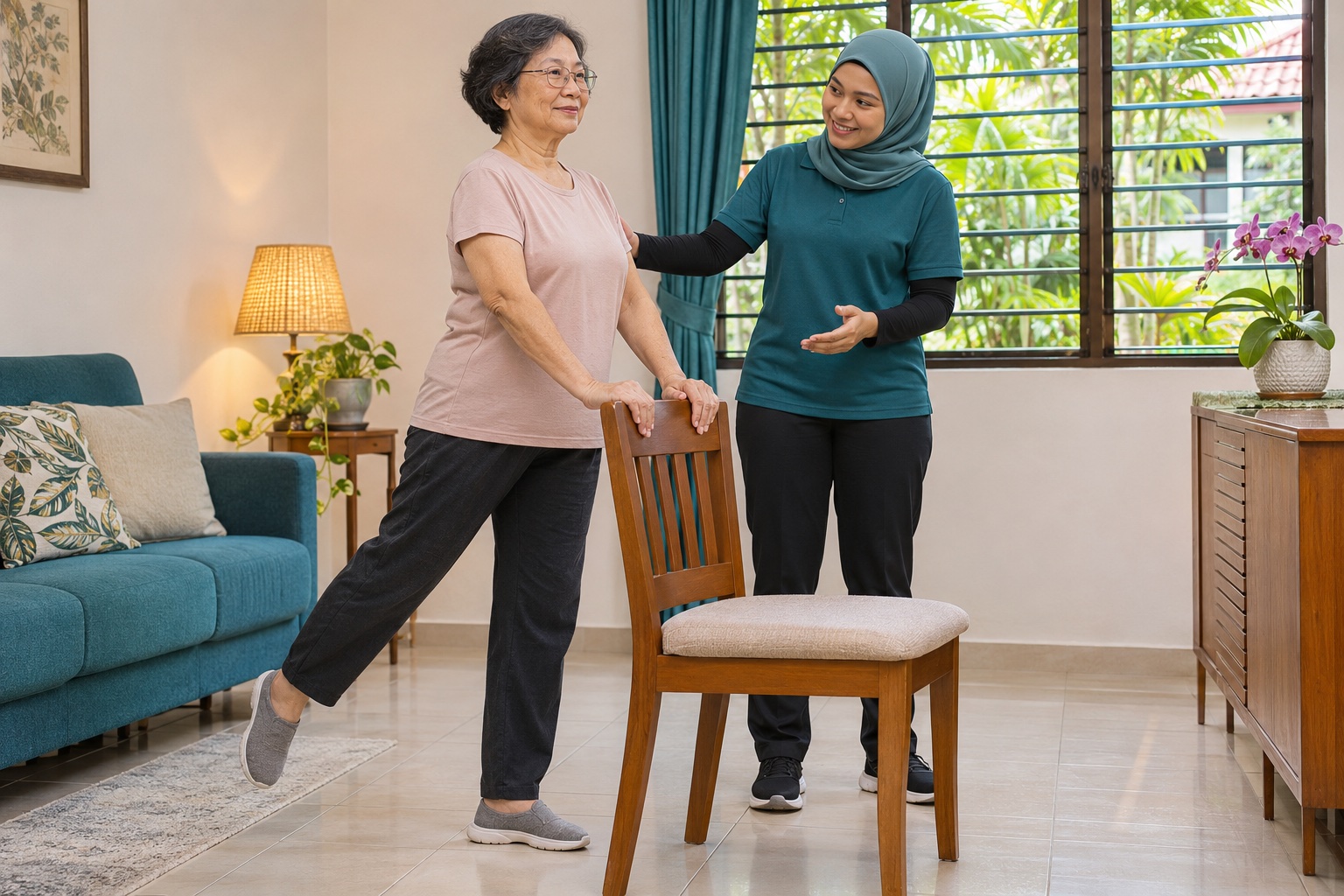
- Observe sitting, reaching and stepping accuracy with support.
- Ask about falls, vision, swallowing and tasks that worsen with fatigue.
Treatment options and how they are chosen
Supported reaching
- What it involves
- Practise reaching for a stable target from a supported seat.
- Why it may be chosen
- Trunk instability can magnify arm inaccuracy.
- The everyday goal
- Help bring a cup or spoon within reach.
- Adapting it at home
- Use an unbreakable object on the actual dining table.
- Reviewing progress
- Compare accuracy and effort rather than speed alone.
Stepping and turns
- What it involves
- Rehearse one direction change with appropriate support.
- Why it may be chosen
- Poor timing can make a turn less stable than a straight walk.
- The everyday goal
- Navigate around a chair without a near-fall.
- Adapting it at home
- Choose a clear route and avoid unsupervised balance challenges.
- Reviewing progress
- Review hand support, foot placement and near-stumbles.
Adaptation and pacing
- What it involves
- Separate tasks that combine carrying and walking if unsafe.
- Why it may be chosen
- Coordination can deteriorate with fatigue or divided attention.
- The everyday goal
- Make bringing a meal to the table safer.
- Adapting it at home
- Move items closer or arrange assistance with hot liquids.
- Reviewing progress
- Record whether the task is completed safely at different times.
Individual rehabilitation goals
- Reach a cup with fewer spills.
- Turn safely in a narrow space.
- Recognise when to sit for a two-handed task.
How a home visit is arranged
- Send a brief enquiry with the rehabilitation need, area and whether you are the patient or caregiver.
- The team checks relevant information, service scope, therapist availability and suitability. Share medical documents through the arrangement agreed with the team.
- If suitable, confirm the appointment, full session fee and separate travel charge before the home assessment.
- The physiotherapist assesses the person and discusses an individual plan, consent and practical goals.
- Appropriate treatment, home practice and caregiver guidance are provided, then progress and the need for further visits are reviewed.
Preparing for the visit
Describe the most recent fall and show the task you wish to improve. Have your usual aid available.
Home visits and clinic rehabilitation
Home suits observation of real tasks. New unexplained ataxia, specialist diagnostic testing, or speech and swallowing assessment needs the appropriate medical or therapy service.
When medical assessment is needed
Sudden loss of balance or coordination, especially with double vision, severe headache, slurred speech or one-sided weakness, needs immediate emergency assessment for possible stroke.
For a genuine medical emergency in Malaysia, call 999. A routine physiotherapy enquiry is not an emergency response. Malaysia emergency service information
Patient and caregiver questions
Is ataxia a diagnosis on its own?
It describes a problem with coordination; a clinician investigates the cause.
Why assess sitting when I want to walk?
Trunk control affects standing, reaching for a rail and recovering balance.
Will faster practice help?
Accuracy and safety matter more than speed; the task should match your current control.
Can I carry hot drinks while practising?
Avoid a task that risks burns. Begin with a safe object under supervision.
What if speech also changes?
A sudden change needs emergency assessment; longer-standing difficulties can be referred for speech and language therapy.
The treating physiotherapist
Penang HomePhysio confirms that a clinician is available for this service. Ask the team to confirm the treating physiotherapist's name, qualifications, registration, relevant experience and availability. Tell us your preferred spoken language so the team can check. Website language options do not establish any individual clinician's language abilities.
About the serviceHome visits around Penang
Home visits in Penang are arranged by area and therapist availability. Areas listed on this site include George Town, Bayan Lepas, Butterworth, Bukit Mertajam. Share your postcode and access needs so the team can confirm coverage and travel charges.
See coverage areasPricing and suitability enquiries
See this site's pricing guide. Tell the team your area and care needs to confirm the full fee, including any travel charge, before booking.
Clinical information sources
These sources support the general information. They are not endorsements of this provider or a claim that a clinician has reviewed this page.